This majestic photo of Misa di Willibrordus by awesome photographer Brett Russel popped up in my Instagram feed today and created an immediate pang of homesickness… while jauntily crossing 14th Street in Manhattan (clutching my iPhone, of course). Funny thing is I’m actually not Catholic (I’m Sephardic Jewish) yet Curaçao’s yellow churches are iconic “Curaçao”… as iconic as our cerulean water (the envy of Photoshop), miles and miles of cactus landscape and psychedelic Handelskade… and they also provide spiritual respite to 85% of Curaçao’s population. A few months ago I had an interesting email exchange with (my friend and) Anthropologist Louis Philippe Römer as well as my aunt Rita Mendes-Flohr related to the historical origins of Roman Catholicism in Curaçao, so I thought I’d share.
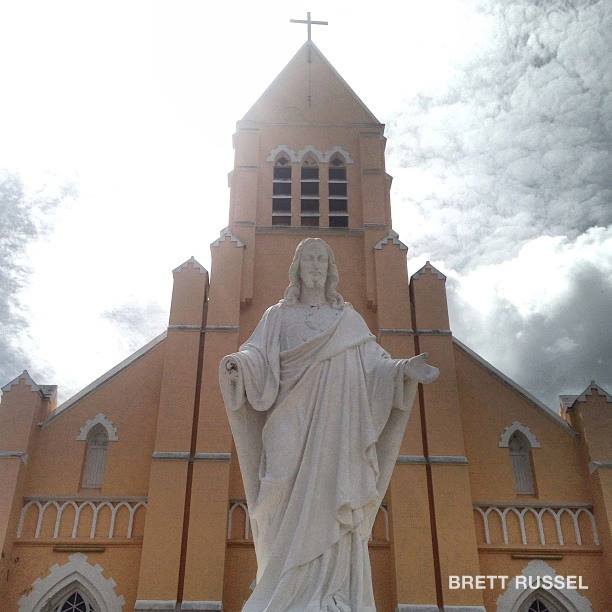
Misa di Willibrordus (1884-1888). Photo by Brett Russel.
Roman Catholicism dates back to Spaniard Alonso de Ojeda’s discovery of Curaçao in 1499. According to Louis Philippe, “some believe that when the Dutch arrived in 1634 most of the Catholic Indians fled to Tierra Firme along with the Spanish, but this can’t be true… how would a tiny Dutch rew survive all alone on a dry, deserted Caribbean island?” [Lost, anyone?] Unique among colonizers, the religiously tolerant Dutch, who were (and still are) predominantly Protestant, didn’t bother to convert religious beliefs upon colonizing Curaçao. Instead they allowed Catholic priests from Coro (Venezuela) and other parts of the Spanish Americas (Dominican Republic, Colombia) to come over and convert African slaves (and whomever was interested). The Dutch tended to embrace these missionaries because they often sought to create economic (= trade), social and cultural ties in addition to evangelizing Catholicism.

Misa di Soto. Source: panoramio.com

Misa di Westpunt.


Source: bankasa.com.

Misa di Willibrordus. Source: strick.net.

Misa di Bonam. Photo by Loek Heijst.
Granted the churches you see in these photos express a distinct Dutch colonial architectural style (to match the Landhuizen and much of Willemstad) — most were built after the arrival of Human Rights activist and Dutch Roman Catholic missionary Monsignor Martinus Joannes Niewindt in 1824. Monsignor Niewindt led the establishment of small parishes (consisting of schools and churches) throughout Curaçao between 1824 and 1860 and played a critical role in abolishing slavery (1863), educating our black rural population, and facilitating Roman Catholic religion in our spoken language, Papiamentu.
Curacao Catholic Church directory.
(Masha danki Brett, Louis Philippe and Rita!)


 1000 Awesome Things About Curaçao
This was lovelly to read